- A smartphone is its brain Navi uses the camera, microphone, display and processing of a paired iOS or Android phone for voice, vision and AI features.
- Twelve-motor quadruped gait Twelve joint motors with dynamic gait balance reach 2 m/s, turn at up to 360° per second and clear obstacles up to 34 cm.
- From block code to Python Learners start with visual block programming and move on to the Python SDK and open motion, perception and hardware-expansion APIs.
- Made to be customised A neutral chassis and soft body wrap take custom skins, stickers and 3D-printed head modules.
- Room for extra hardware Four back mounting bolts, 5 V and 12 V power outputs and a USB port accept add-on sensors and devices.
- About two hours per charge The built-in lithium battery runs for roughly two hours and charges directly from a US-spec plug.


Description
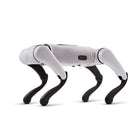
FX Navi is Faraday Future's entry-level quadruped: an 8 kg, 12-motor robot built for STEM education, coding practice and early embodied-AI projects at home, in class or in the lab. It is designed to be owned, programmed and customised by learners rather than deployed as a working machine, and it is intended for indoor flat ground.
The most important thing to understand before buying is how it thinks. Navi pairs with an iOS or Android smartphone and uses the phone's camera, microphone, display and processing for vision, voice and AI features, including conversation in 50 languages. The phone is not part of the package, which holds the robot, a remote controller and a charger, so plan for a compatible handset per robot.
Mechanically, twelve joint motors with dynamic gait balance give a top speed of 2 m/s, rotation at up to 360° per second and obstacle clearance up to 34 cm. The built-in lithium battery of about 0.2–0.3 kWh runs for roughly two hours and charges directly from a US-spec plug; an automatic charging dock is an optional extra.
For teaching, Navi runs a learning path from visual block programming to a Python SDK with open low-level interfaces for motion control, perception and hardware expansion, and it receives updates over the air. Four back mounting bolts, 5 V and 12 V power outputs and a USB port take add-on sensors, while the neutral chassis and soft body wrap accept custom skins and 3D-printed head modules. Faraday Future designs it for users aged 14 and over, and younger children should use it with an adult.
Key Capabilities
- Compact quadruped: About 8 kg with 12 joint motors and dynamic gait balance for indoor flat ground.
- Agile movement: Up to 2 m/s, rotation at up to 360° per second and obstacle clearance up to 34 cm.
- Phone-powered intelligence: Vision, voice and multilingual AI run through a paired iOS or Android smartphone and the app.
- Open development: Visual block programming, a Python SDK and open low-level APIs, with over-the-air updates.
- Expressive behaviour: Around ten lifelike expressions and five or more biomimetic behaviours.
- Hardware expansion: Back mounting bolts, 5 V / 12 V power outputs and a USB port for add-on sensors.
Buying through Robotix Market
This unit is sourced new through established distribution channels and ships worldwide with the full manufacturer warranty. Technical support is coordinated with the manufacturer's own service network. Deployment scope, configuration, and commissioning responsibilities are agreed as part of the quotation — on-site installation is not included in the product price.
Features
Specs
| Brand | Faraday Future |
|---|---|
| Model | FX Navi |
| Product Type | Educational quadruped robot |
| Dimensions | 112 mm (308 mm standing) × 298 mm × 515 mm |
| Weight | ≈ 8 kg |
| Degrees of Freedom | 12 (12 joint motors) |
| Maximum Speed | 2 m/s; rotation up to 360°/s |
| Obstacle Clearance | Up to 34 cm |
| Terrain | Indoor flat ground; dynamic gait balance |
| Payload | Confirm at quote |
| Battery | Built-in lithium battery, ≈ 0.2–0.3 kWh |
| Runtime | ≈ 2 h |
| Charging | Direct charging, US-spec plug; automatic charging dock optional (sold separately) |
| Battery Protection | Over-current, over-voltage, over-temperature |
| Connectivity | Wi-Fi, Bluetooth, 4G/5G |
| Perception | Via a paired iOS or Android smartphone (camera, microphone, display) |
| AI Features | LLM / VLM voice interaction in 50 languages, via smartphone and app |
| Operating System | Linux (developed by Faraday Future) |
| Onboard Compute | Confirm at quote |
| Development | Visual block programming; Python SDK; open low-level motion-control, perception and hardware-expansion APIs |
| Expansion | Four back mounting bolts, 5 V / 12 V power output, USB port |
| Control | Mobile app and remote controller |
| Expressions | About 10 expressions; 5+ biomimetic behaviours |
| Recommended Age | 14+; younger children with an adult |
| What's in the box | 1 × quadruped robot, 1 × remote controller, 1 × charger (smartphone not included) |
Industries
Frequently Asked Questions
Yes. It uses a paired iOS or Android phone for its camera, microphone, display and AI processing. A phone is not included; the box contains the robot, a remote controller and a charger.
Up to 2 m/s, with rotation at up to 360° per second and obstacle clearance up to 34 cm. It is designed for indoor flat ground.
Yes. Beginners use visual block programming; advanced users work with the Python SDK and open low-level interfaces for motion control, perception and hardware expansion.
Navi charges directly from a US-spec plug. If you are ordering for another country, ask us to confirm the charger and plug arrangement for your mains supply before you order.
Faraday Future designs Navi for users aged 14 and over, and younger children should use it with an adult.
The FX Navi Quadruped Robot is priced at SAR 7,811 in your market.
Recently Viewed
You haven't viewed any products yet.